
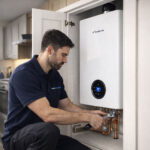
Boiler short cycling happens when your boiler keeps switching on and off repeatedly in short bursts, rather than completing a full heating cycle. The most common causes include low boiler pressure, an oversized boiler, a faulty thermostat, a blocked heat exchanger, and pump problems.
If your boiler is doing this, you are not alone, and the good news is that most causes are fixable.

What Causes Boiler Short Cycling?
Boiler short cycling is most commonly caused by issues with pressure, thermostat settings, or a boiler that is simply too big for the home it is heating. Below, we break down each cause in plain English so you know exactly what you are dealing with and what to do about it.
Low Boiler Pressure
Low boiler pressure is one of the most frequent triggers of short cycling. When the pressure inside your boiler drops too low, typically below 1 bar, the boiler struggles to distribute hot water around your heating system properly. It fires up, senses something is wrong, and shuts itself down again almost immediately.
This can repeat dozens of times a day, putting unnecessary strain on your boiler’s components and increasing your energy bills.
You might notice the pressure gauge on your boiler sitting below the green zone, or your radiators not heating up properly. A slow pressure drop over time often points to a small leak somewhere in the system, while a sudden drop can indicate a fault with the pressure relief valve.
How to Fix Low Boiler Pressure
- Locate the filling loop on your boiler, which is usually a small flexible hose underneath the unit.
- Slowly open the valves on the filling loop until the pressure gauge reads between 1 and 1.5 bar.
- Close both valves once the correct pressure is reached.
- Reset your boiler using the reset button and monitor the pressure over the next few days.
- If the pressure keeps dropping, call a Gas Safe registered engineer to check for leaks in the system.
An Oversized Boiler
An oversized boiler is a surprisingly common cause of short cycling, and it is one that many homeowners do not immediately think of. If your boiler produces far more heat than your home actually needs, it heats the water too quickly, reaches its target temperature almost instantly, and then shuts off.
A few minutes later, the temperature drops, and the whole cycle starts again.
This is particularly common in homes where a large boiler was installed without a proper heat loss calculation being carried out first. It is also something to be aware of if you have recently had loft insulation or double glazing installed, as your home’s heat requirements will have reduced.
Solution
- Book a heating assessment with a qualified engineer who can carry out a proper heat loss survey of your home.
- Ask your engineer to check whether your boiler’s output can be turned down, as many modern boilers have modulating burners that can be adjusted.
- If the boiler cannot be adjusted and is significantly oversized, discuss replacement options with a heating engineer.
- When replacing, ensure the new boiler is sized correctly using industry standard heat loss calculations, not just a rough guess based on the number of bedrooms.
A Faulty or Poorly Positioned Thermostat
A faulty thermostat, or one that has been placed in the wrong location, can easily cause short cycling. If the thermostat is sitting in a warm spot, such as near a radiator, in direct sunlight, or in a south-facing room that warms up quickly, it will read the room as warmer than it actually is.
This tricks the boiler into thinking the target temperature has been reached far too soon, causing it to shut off before the rest of the home has warmed up.
Older thermostats can also develop faults that cause them to send incorrect signals to the boiler, resulting in the same stop-start behaviour.
How to Fix a Faulty or Poorly Positioned Thermostat
- Check where your thermostat is located and move it away from heat sources, direct sunlight, or draughty areas if possible.
- Test the thermostat by setting it a few degrees higher than the current room temperature and checking whether the boiler fires up and runs for a reasonable amount of time.
- If the thermostat is old or unresponsive, consider upgrading to a modern smart thermostat, which offers much more accurate temperature control.
- Have a Gas Safe engineer check the thermostat’s wiring and calibration if problems persist.
A Blocked or Dirty Heat Exchanger
The heat exchanger is the part of your boiler that transfers heat from the burner to the water in your central heating system. Over time, limescale, sludge, and debris can build up inside it, particularly in hard water areas like many parts of the Midlands.
When the heat exchanger becomes blocked, heat cannot transfer efficiently, causing the boiler to overheat rapidly and trigger its safety cutout, which shuts the boiler down.
This is a pattern you will notice more in older boilers or systems that have never been power flushed. The boiler fires up, overheats almost immediately, cuts out, cools down, and then fires up again.
How to Fix a Blocked Heat Exchanger
- Do not attempt to clean the heat exchanger yourself, as this is a job for a Gas Safe registered engineer.
- Book a boiler service, during which the engineer can inspect and clean the heat exchanger.
- If the build-up is significant, ask about a power flush or a chemical flush of the entire system to remove sludge and debris.
- Consider having a magnetic filter fitted to your system to catch debris before it reaches the boiler.
- Use a quality central heating inhibitor to help prevent future scale and sludge build-up.
Circulation Pump Problems
Your central heating pump is responsible for pushing hot water around your radiators and back to the boiler. If the pump is faulty, running too slowly, or set to the wrong speed, hot water can build up around the heat exchanger faster than it can be distributed.
This causes the boiler to overheat and cut out, starting the short cycling pattern.
A pump that is running too fast can also cause issues, as it can prevent the water from picking up enough heat before returning to the boiler, causing the boiler to fire again almost immediately.
How to Fix Circulation Pump Problems
- Listen for unusual noises from your pump, such as grinding or humming, which can indicate a fault.
- Check whether your pump has a speed setting and ask your engineer whether it is set correctly for your system.
- Bleed the pump if there is air trapped inside it, as this is a common reason for reduced flow.
- If the pump is old or damaged, have a Gas Safe engineer replace it, as a new pump is relatively affordable and can make a significant difference to your system’s performance.
A Faulty Printed Circuit Board (PCB)
The printed circuit board, or PCB, is essentially the brain of your boiler. It controls when the boiler fires, how long it runs, and when it shuts off. If the PCB develops a fault, it can send incorrect signals that cause the boiler to behave erratically, including short cycling.
PCB faults are less common than the other causes on this list, but they do happen, particularly in older boilers. Unfortunately, they are one of the more expensive repairs to carry out.
How to Fix a Faulty PCB
- Check whether your boiler is displaying any fault codes on its display panel, as these can point directly to a PCB issue.
- Do not attempt any PCB repairs yourself, as this must be handled by a qualified engineer.
- Get a Gas Safe engineer to run a full diagnostic on your boiler to confirm the PCB is the cause.
- Ask your engineer whether repairing the PCB is cost-effective compared to replacing the boiler. If your boiler is over 8 years old, a new boiler is usually the better option.
How Can You Prevent Boiler Short Cycling in the Future?
Preventing short cycling in the future comes down to regular maintenance and making sure your boiler is set up correctly for your home from day one. Here are the key steps you can take:
- Book an annual boiler service with a Gas Safe registered engineer to catch any issues before they become serious problems.
- Have a magnetic system filter fitted to trap sludge and debris before they reach your boiler.
- Use a central heating inhibitor and top it up during your annual service to protect against scale and corrosion.
- Make sure your thermostat is positioned correctly, away from heat sources and direct sunlight.
- When replacing a boiler, always insist on a proper heat loss survey to ensure the new boiler is correctly sized for your home.
- Monitor your boiler pressure regularly and repressurise when needed, keeping it between 1 and 1.5 bar.
- Bleed your radiators at least once a year to remove trapped air, which can affect water circulation and put strain on your boiler.
Get a Free Quote from Clever Energy Boilers
Short cycling puts real wear and tear on your boiler. Every time it fires up and shuts down in quick succession, it is burning fuel inefficiently and stressing its internal components. Over time, this shortens the lifespan of your boiler and pushes your energy bills higher than they need to be.
If you have tried the fixes above and your boiler is still short cycling, or if your boiler is over 8 years old, a new boiler is usually the best option, as older boilers are usually less efficient. A new A-rated condensing boiler will run far more efficiently, heat your home more evenly, and put an end to the frustrating stop-start cycle you have been dealing with.
At Clever Energy Boilers, we install high-quality boilers across the North West, Yorkshire, and the Midlands. Our heating engineers are Gas Safe registered, and we take the time to correctly size every boiler we install so you never have to deal with an oversized or underpowered unit.
Whether you are a homeowner looking to upgrade an ageing system or a landlord needing a reliable boiler for a rental property, we are here to help.
Request your free, no-obligation boiler quote today and let Clever Energy Boilers sort your heating out properly.
Frequently Asked Questions
Is boiler short cycling dangerous?
Short cycling is not immediately dangerous in most cases, but it should not be ignored. It puts excessive strain on your boiler’s components, leading to premature wear and a higher risk of a breakdown.
If the short cycling is caused by a pressure or overheating issue, your boiler’s safety devices are doing their job by shutting it down, but the underlying fault still needs to be investigated by a Gas Safe engineer.
How long should a boiler run before switching off?
A boiler working normally should run for roughly 10 to 15 minutes per heating cycle before switching off once the target temperature has been reached. If yours is switching off after just 2 to 3 minutes, or cycling on and off several times within an hour, that is a strong sign that something is not right and the system needs attention.
Can short cycling increase my gas bills?
Yes, it can. When a boiler short cycles, it uses a burst of energy every time it fires up, which is the most fuel-intensive part of the heating process. Running many short cycles throughout the day instead of fewer, longer, efficient ones means your boiler is burning more gas than it needs to, which will show up on your energy bills over time.
Will a smart thermostat help with short cycling?
A smart thermostat can help in cases where a poorly calibrated or badly positioned thermostat is the root cause of the problem. Smart thermostats offer more precise temperature sensing and can be placed more strategically around your home.
However, if the short cycling is caused by a mechanical fault, low pressure, or an oversized boiler, a new thermostat alone will not resolve the issue.
Does short cycling affect my boiler’s warranty?
It can depending on the circumstances. If a boiler short cycles because it was incorrectly installed or poorly sized, and this leads to component failure, a warranty claim may be declined. This is one of the reasons it is so important to have your boiler installed by a qualified engineer who carries out proper system sizing and setup from the start.