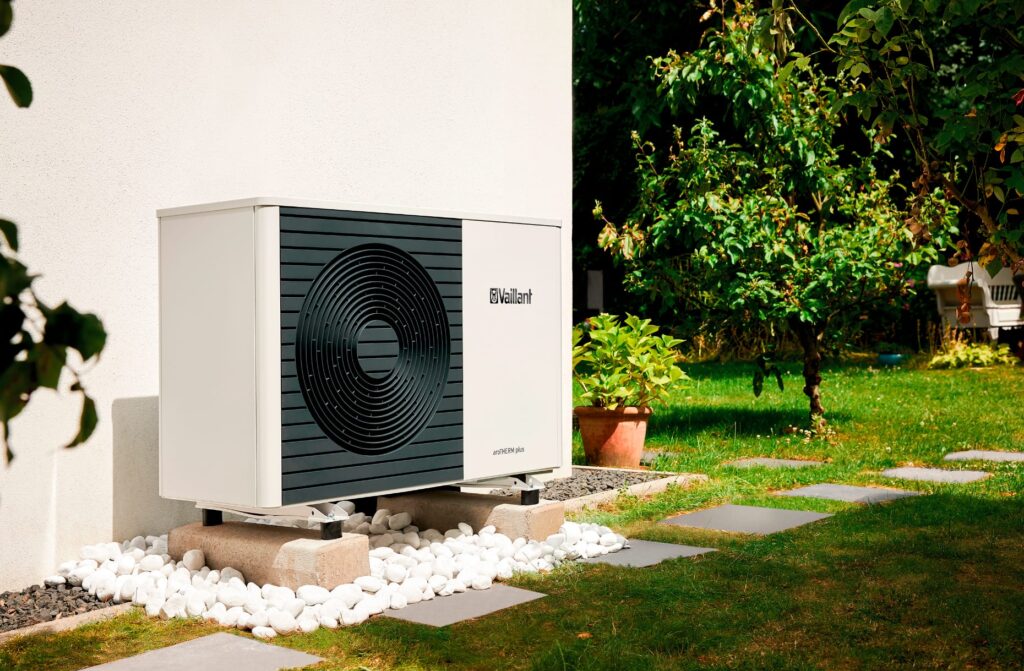
An air-to-air heat pump takes heat from the air outside and blows it into your rooms as warm air. It’s the same kit as a modern split air conditioner, running in reverse: one outdoor unit, one or more slim indoor units on the wall, and a remote or app to switch between heating and cooling. It doesn’t heat your hot water or feed radiators, so it works best as the main heat for a few key rooms, or as a cheaper way to warm a home that currently relies on electric heaters.
We install air-to-air systems across Yorkshire, the North West and the Midlands from our base in Bingley, and this guide covers what we get asked most: how they work, what they cost to fit and run, and whether one makes sense for your home. If you already know you want one, you can request a free quote and we’ll take it from there.
How does an air-to-air heat pump work?
It moves heat rather than making it. A refrigerant circulates between the outdoor and indoor units. Outside, it absorbs warmth from the air (even on a cold day there’s plenty to collect), the compressor raises its temperature, and the indoor unit releases that heat into the room with a quiet fan. Flip it into cooling mode in summer and the process runs the other way, pulling heat out of the room.
Because it’s moving heat instead of burning fuel, it puts out several units of heat for every unit of electricity it uses. That ratio is the reason running costs can be low, and it’s what the efficiency figures on the label are telling you.
Is an air-to-air heat pump just air conditioning?
Pretty much, yes. Most wall-mounted split air conditioners sold in the UK are reversible, which makes them air-to-air heat pumps. HMRC’s own guidance says most air conditioning units are air source heat pumps. The difference is how you use it: here in Yorkshire, most of our customers want heat for eight or nine months of the year and cooling for a few weeks in summer, so we size and position the indoor units with heating in mind. Our guide to air-to-air heat pumps vs air conditioning clears up the confusion between the two names.
That’s why we install systems from Midea and Bosch, such as the Bosch Climate 3200i, which carry good heating ratings as well as cooling ones.
How efficient is an air-to-air heat pump?
Look for the heating SCOP (seasonal coefficient of performance) on the energy label. A SCOP of 4 means that across a typical heating season, you get roughly 4kWh of heat for every 1kWh of electricity. The label grade gives you a quick guide:
| Heating energy label | Seasonal efficiency (SCOP) | Heat out per 1kWh of electricity |
|---|---|---|
| A | 3.4 to 4.0 | About 3.4 to 4kWh |
| A+ | 4.0 to 4.6 | About 4 to 4.6kWh |
| A++ | 4.6 to 5.1 | About 4.6 to 5.1kWh |
| A+++ | 5.1 and above | More than 5.1kWh |
Real-world efficiency drops a little on the coldest days and rises in mild weather, which is why the seasonal figure is more useful than a single test point.
What does it cost to run?
For most homes, heating with an air-to-air heat pump costs less than heating with direct electric heaters by a wide margin, and it can undercut a gas boiler too. Here’s a worked example for heating a lounge and two bedrooms that need around 4,000kWh of heat a year, using the Ofgem price cap for October to December 2026 (electricity 26.32p per kWh, gas 7.97p per kWh, standing charges not included):
| Heating method | Energy bought | Approximate yearly cost |
|---|---|---|
| Air-to-air heat pump (SCOP 4) | 1,000kWh electricity | £263 |
| Gas boiler (90% efficient) | 4,444kWh gas | £354 |
| Electric panel or fan heaters | 4,000kWh electricity | £1,053 |
Your own figures will depend on how well the house holds heat, the temperatures you like and your tariff. Prices also change every three months, so treat this as a comparison rather than a promise. If you have an off-peak or heat pump tariff, the gap can widen further.
How much does an air-to-air heat pump cost to install?
Most of our customers pay between £1,600 and £2,800 for a single-room system, supplied and fitted. Heating two or three rooms from one outdoor unit usually lands between £3,200 and £6,500, and larger multi-room systems start from around £5,000.
| System | Rooms | Typical installed cost (2026) |
|---|---|---|
| Single wall-mounted split | 1 | £1,600 to £2,800 |
| Small multi-split | 2 to 3 | £3,200 to £6,500 |
| Larger multi-split | 4 or more | £5,000 to £9,000+ |
Two things can bring that down. Since 28 April 2026, air-to-air heat pumps can qualify for a £2,500 Boiler Upgrade Scheme grant in England and Wales. And installation of a fixed heat pump in a home is currently zero-rated for VAT until 31 March 2027. There’s more detail on pricing in our air conditioning installation cost guide, and you can spread the cost with monthly finance.
Which homes suit an air-to-air heat pump?
They’re a strong fit if any of these sound like your home:
- You heat with electric storage heaters, panel heaters or an old electric fire, which is common in flats and some bungalows.
- You’ve got a room the central heating never quite reaches, like a loft conversion, a garden room or a cold extension.
- You want summer cooling in a bedroom or home office and would like the same unit to take the edge off the heating bill in spring and autumn.
- You live in a flat with no space for a hot water cylinder, which rules out most air-to-water systems.
They’re less suited as the only heating in a large family home with lots of rooms, because you’d need an indoor unit in most of them and you’d still need another way to heat water. In that case, an air source heat pump with radiators or a new efficient boiler is usually the better whole-house answer. Our guide to air-to-air vs air-to-water heat pumps compares the two side by side.
Will it heat my home properly in a Yorkshire winter?
Yes, if it’s sized correctly. Modern units keep producing heat well below freezing, and a correctly sized indoor unit warms a room quickly because it blows heated air rather than waiting for a radiator to warm up. Older stone terraces around Bradford, Keighley and Halifax can lose heat fast through solid walls, so we work out the heat loss for each room during the survey rather than guessing from floor area. Our guide on what size unit you need explains how that works.
Do I need planning permission?
Usually not in England. Since 29 May 2025, air-to-air heat pumps get the same permitted development rights as other air source heat pumps, as long as the outdoor unit meets the noise rules and size limits. Listed buildings, flats and conservation areas can have extra steps, so check our planning permission guide or ask us during your survey.
What’s involved in getting one fitted?
Most single-room installs are done in a day. You fill in our online form, we survey your home remotely using photos or a short video you send us, and you get a written installation plan and quote. On the day, our engineers mount the indoor unit, run the pipework and cable through a small hole in the wall, fit the outdoor unit on the ground or a wall bracket, and commission the system. Before we leave, we’ll show you how to use the heating and cooling modes and the app.
Afterwards, an annual service keeps the filters clean and the system running efficiently, and you can add an air conditioning servicing plan when you book.
Is an air-to-air heat pump worth it?
For a home on electric heating, almost always: you’re likely to cut the heating cost of those rooms by well over half and gain cooling for summer. For a home on gas, it’s worth it for rooms that are hard to heat or that you want to cool, and as a way to lean less on the boiler in milder months. If you’re not sure, get a free quote or read more about our air conditioning and air-to-air heat pump installation and we’ll tell you honestly whether it suits your home.