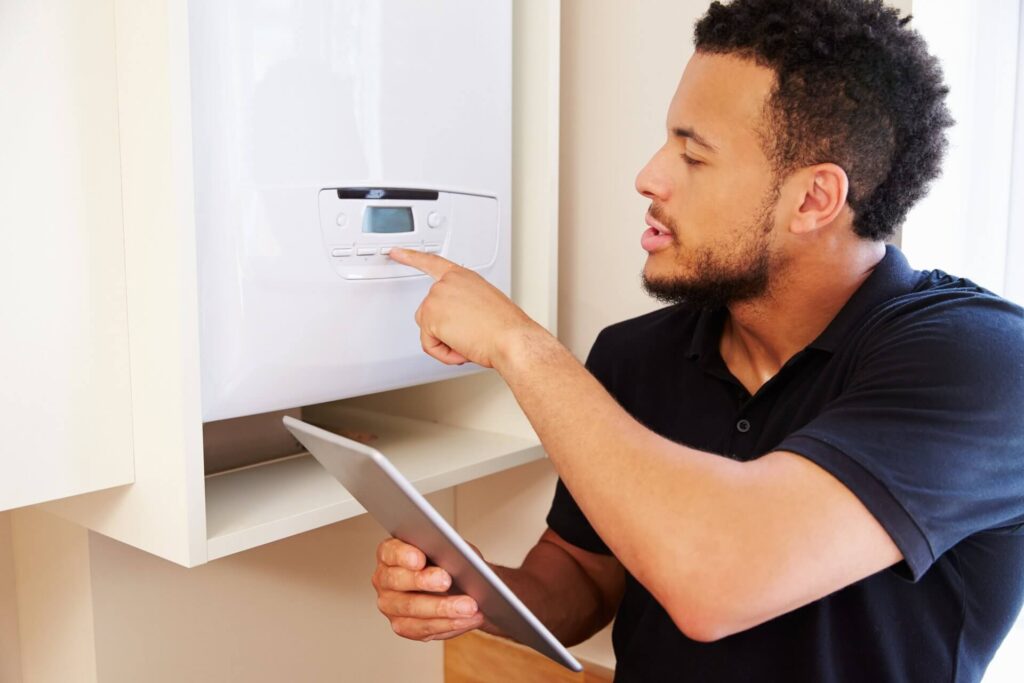
A smart thermostat can cut your heating bill, but how much depends on where you’re starting from. If your heating runs on an old dial thermostat with no schedule, or gets left on when nobody’s home, the savings can be real. If you already use a programmer and room thermostat well, expect a modest gain at best.
This guide sets out realistic savings using figures from the Energy Saving Trust and Which?, and explains how smart thermostats actually reduce gas use. It also checks compatibility with combi, system and regular boilers. Finally, it compares Hive, Google Nest, tado and Drayton Wiser as they stand in 2026, including Google’s exit from the European thermostat market.

How Much Can A Smart Thermostat Save?
Anything from very little to around £100 a year, depending mostly on how good your current controls are. There’s no single figure, and you should be wary of anyone who quotes one.
Manufacturers publish their own savings claims. These are based on their own customer data, though, and usually compare against homes with poor controls to begin with.
Independent UK figures are more cautious. The Energy Saving Trust estimates that a full set of heating controls could save a typical home in Great Britain around £100 a year. By a full set, it means a programmer, a room thermostat and thermostatic radiator valves.
Its figures also show that turning the thermostat down by one degree, from 22°C to 21°C, could save around £120 a year. Which? notes that savings are much less clear if you already have a device to control and schedule your boiler.
| Your starting point | Realistic saving from going smart |
| No room thermostat or programmer, heating controlled at the boiler | The biggest gains. The Energy Saving Trust puts a full set of heating controls at around £100 a year |
| Heating often left on when the house is empty | Worthwhile savings from scheduling and away-from-home features, as long as you use them |
| Thermostat set higher than needed | Around £120 a year from turning it down one degree, from 22°C to 21°C (Energy Saving Trust) |
| Every room heated to the same temperature all day | Further savings from room-by-room zoning with smart radiator valves |
| Programmer and room thermostat already used well | Small. Which? says savings are less clear for homes that already schedule their heating |
Energy prices change, so treat any pound figure as a guide. The pattern holds, though. The less control you have now, the more a smart thermostat can save.
How Do Smart Thermostats Cut Heating Bills?
They make it easier to heat your home only when and where you need it. These are the features that do the work:
- Scheduling from your phone. Setting heating times in an app is far easier than reprogramming an old timer, so people tend to keep schedules that match their routine.
- Remote control. If plans change, you can switch the heating off or turn it down from wherever you are.
- Away-from-home detection. Geofencing uses your phone’s location to lower the heating when the last person leaves and bring it back as someone heads home.
- Room-by-room zoning. Paired with smart radiator valves, some systems heat each room to its own schedule, so spare bedrooms aren’t heated all day.
- Boiler modulation. Thermostats that support OpenTherm tell the boiler how much heat is needed. The boiler can then run at a lower, steadier output instead of switching fully on and off, which keeps a condensing boiler in its most efficient mode.
- Weather awareness. Some systems use the outdoor temperature to adjust heating times and output, warming the house more gently on mild days.
Which? notes that compensation controls of this kind could save as much as 10% on gas bills. It also stresses that they’re only one part of the heating system. Radiators, insulation and the boiler itself all matter too.
When Won’t A Smart Thermostat Save You Money?
When your current controls already work well, or when the real problem lies elsewhere in the house. A smart thermostat is a tool, and it won’t cut your bills on its own if:
- You already have a programmer and room thermostat set to a sensible schedule
- Someone’s at home most of the day and the heating needs to stay on anyway
- You turn the temperature up because you can, rather than turning it down
- You stop using the app after the first few weeks
- The real problem is poor insulation, a badly balanced system or an old, inefficient boiler
In that last case, a new A-rated condensing boiler or better insulation will usually do more for your bills than any thermostat. Our guide to how much a new boiler costs explains what replacing an old boiler involves.
Is A Smart Thermostat Compatible With Your Boiler?
Almost certainly, as most smart thermostats work with most UK gas boilers. The details still matter, though.
Which Smart Thermostat Works With A Combi Boiler?
Any of the models in this guide. Combis heat hot water on demand, so you only need a single-channel thermostat to control the heating. If your boiler supports OpenTherm, pick a thermostat that does too and you’ll get modulating control.
What If You Have A System Or Regular Boiler?
You’ll want a model that can schedule your hot water as well as your heating. That usually means a two-channel or hot water version of the thermostat or receiver.
A system with separate heating zones may need a multi-channel setup.
Does Your Boiler Support OpenTherm?
Many Ideal, Baxi and Vokera boilers do, as OpenTherm is the most common digital language between UK boilers and thermostats. Vaillant and Glow-worm boilers use their own eBUS system and need an add-on module for OpenTherm.
Worcester Bosch boilers use their own EMS system and work best with Worcester’s own controls. A standard on/off smart thermostat can still switch them, though.
Can You Use A Smart Thermostat With A Heat Pump?
Sometimes, but ask your installer first. Heat pumps run best on long, low-temperature cycles with weather compensation, and they’re usually run by the manufacturer’s own controls.
What Do The Boiler Plus Rules In England Require?
Since 2018, new combi boilers fitted in England must come with time and temperature controls plus at least one extra energy-saving measure. A smart thermostat with automation and optimisation features is one of the accepted options. The others are weather compensation, load compensation and flue gas heat recovery.
How Do Hive, Nest, tado And Drayton Wiser Compare?
Hive is one of the cheapest ways in, tado X and Drayton Wiser are strongest on zoning, and Nest is no longer being developed for Europe. The table compares the four best-known UK brands. Prices are a guide and change often, so check before buying.
| Feature | Hive | Google Nest | tado X | Drayton Wiser |
| Guide price (thermostat or starter kit) | Around £80 to £120, plus a hub if not bundled | Around £200 to £220 for remaining stock | Around £160 for a starter kit with bridge | Around £195 and up for a kit |
| Hub or bridge | Yes, Hive Hub | Heat Link included | Yes, included in starter kit | Yes, included in kit |
| Subscription | Not needed for core heating control | No | Optional Auto-Assist for automatic away mode | No |
| OpenTherm | Yes, on the OpenTherm version | Yes | Yes | Yes, on the single-channel hub |
| Smart radiator valves | Yes | No | Yes | Yes |
| Hot water control | Yes, with the right receiver | Yes, on the Learning Thermostat | Yes, with the right receiver | Yes, on two and three-channel hubs |
| 2026 status | Current | No new thermostats being developed for Europe | Current | Current |
Is Hive A Good Choice?
Yes, especially on a budget. Hive is one of the most familiar names in the UK and one of the cheapest ways into smart heating.
The Hive Thermostat Mini keeps costs down further by leaving most controls to the app. Hive works with most UK gas and LPG systems, and there’s an OpenTherm version for compatible boilers.
Should You Still Buy A Google Nest Thermostat?
We wouldn’t choose Nest for a new installation in 2026, because Google has no successor planned for Europe. The Nest Learning Thermostat learns your routine and builds a schedule for you.
In 2025, Google announced it wouldn’t develop new Nest thermostats for Europe. First and second-generation Nest thermostats lost app control in October 2025, while third-generation models still work. For a head-to-head comparison, see our Hive vs Nest thermostats guide.
Is tado X Worth It?
Yes, if you want room-by-room control. tado X supports OpenTherm, and Google pointed Nest owners towards tado when it left the European market.
Basic control is free. Automatic away mode and some other automations need the paid Auto-Assist subscription, and without it the app sends a reminder instead of acting automatically.
Who Is Drayton Wiser Best For?
Homes that want proper zoning, especially those with cylinders or separate heating zones. Wiser uses smart radiator thermostats and multi-channel hubs to do this.
There’s no subscription, and the hub keeps running your schedule if the internet drops. The app is less polished than some rivals, but the system itself is very capable.
Which Smart Thermostat Should You Choose?
For most combi homes, Hive or tado X is the simplest upgrade. This is how we’d match them to different setups:
- For a simple, low-cost upgrade on a combi: Hive or tado X.
- For room-by-room zoning: Drayton Wiser or tado X with smart radiator valves.
- For a system or regular boiler with a cylinder: a Hive or Wiser setup with hot water control.
- For a Worcester Bosch boiler: consider Worcester’s own controls, which talk to the boiler natively.
- For a Vaillant boiler: Vaillant’s own controls add weather compensation and work with the myVAILLANT app.
Our smart thermostats page shows the models we install.
How Much Does It Cost To Fit A Smart Thermostat In 2026?
Expect around £200 to £350 for a single smart thermostat, supplied and fitted. Adding hot water control or smart radiator valves costs more.
The figures below are guide ranges. Prices vary with the model, the existing wiring and how many rooms you want to control.
| Type of job | Guide price |
| Single smart thermostat, supplied and fitted | £200 to £350 |
| Smart thermostat with hot water control (system or regular boiler) | £250 to £400 |
| Smart thermostat plus smart radiator valves in four to six rooms | £500 to £900 |
Fitting a smart thermostat at the same time as a new boiler is usually the cheapest route. The engineer is already wiring in the controls.
Get A Smart Thermostat Quote From Clever Energy Boilers
Clever Energy Boilers fits smart thermostats and heating controls for homeowners and landlords across the North West, Yorkshire and the Midlands.
Our experienced, professional and registered installers will check your boiler’s compatibility and recommend a thermostat that suits your system. We’ll set it up properly, too, so you actually get the savings it promises.
If your boiler’s also getting on, we can quote for both together. Read more about our new boiler installations, or keep your heating running efficiently with one of our servicing plans.
Get your free, no-obligation boiler and smart thermostat quote online in a few minutes.
Frequently Asked Questions
Do Smart Thermostats Really Save Money?
Yes, mainly in homes that currently have poor controls or leave the heating on when nobody’s in. If you already schedule your heating well, savings are likely to be small.
How Much Will A Smart Thermostat Save Me A Year?
Around £100 a year from a full set of heating controls, according to the Energy Saving Trust, though it depends on your home and habits. It also estimates around £120 a year from turning the thermostat down from 22°C to 21°C.
Do Smart Thermostats Work With Combi Boilers?
Yes. All the main brands work with combi boilers. Choose an OpenTherm model if your boiler supports it, so the thermostat can modulate the boiler rather than just switching it on and off.
Is Google Nest Still Sold In The UK?
Only while remaining third-generation stock lasts, as Google has stopped developing new Nest thermostats for Europe. Older first and second-generation models lost app control in October 2025.
Do I Need An Engineer To Fit A Smart Thermostat?
It’s the safest option, as many kits involve mains wiring at the boiler or wiring centre. Some are sold for DIY fitting, but a qualified engineer will wire it safely, set it up correctly and check it’s compatible with your boiler.