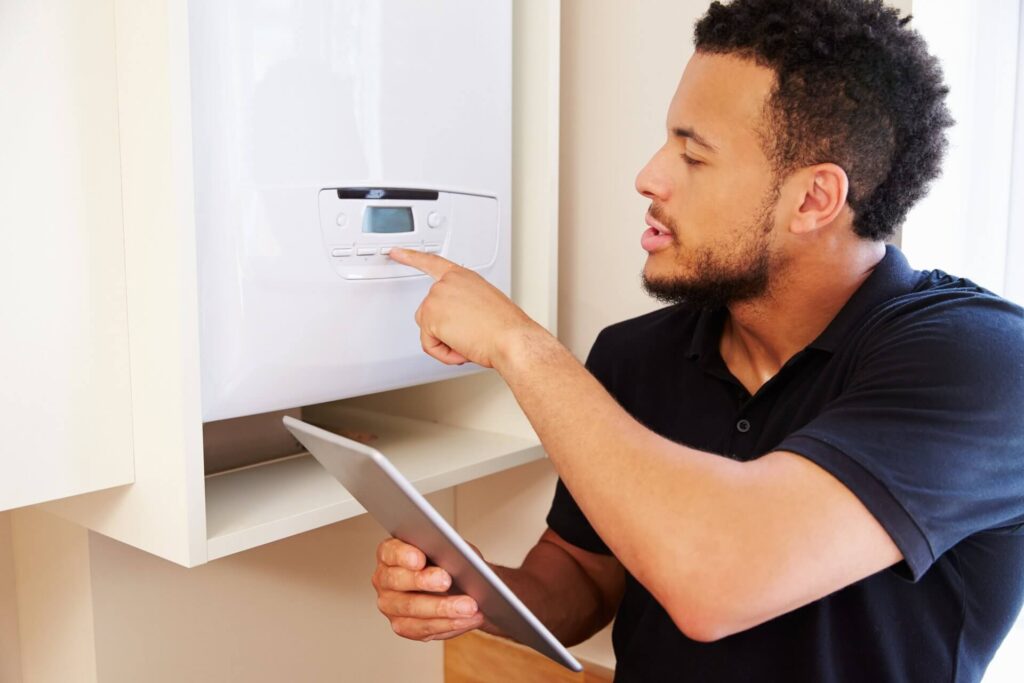
A boiler magnetic filter is a small canister fitted to your central heating pipework that catches black iron sludge (magnetite) before it can reach the boiler. Most homes with a modern gas boiler benefit from one, and on a new installation it should be fitted as standard.
We’re Clever Energy Boilers, a Gas Safe registered (no. 554138) team and accredited Worcester Bosch installers. From our base in Bingley we fit boilers across Yorkshire, the North West and the Midlands, and every week we see what sludge does to heating systems that were never protected.

What is a boiler magnetic filter?
A magnetic filter boiler set-up uses a strong magnet inside a sealed housing to pull tiny particles of iron oxide out of the water in your heating system. Radiators and steel pipework slowly corrode from the inside, and that corrosion turns into a fine black sludge. Left to circulate, it settles in radiators and clogs the pump and boiler.
It won’t stop corrosion (that’s the job of inhibitor in the water), but it removes the debris before it builds up where it does harm.
How does a magnetic filter work?
The filter sits on the return pipe, usually just under the boiler, so all the water coming back from the radiators passes through it before re-entering the boiler. Inside is a magnetic rod in a plastic sleeve. As water flows past, magnetite sticks to the sleeve and stays there.
Many filters also slow or spin the water so heavier non-magnetic bits (sand, flux, scale) drop to the bottom of the housing. Isolation valves either side let an engineer shut it off and clean it without draining the whole system.
Do I need a magnetic filter on my boiler?
For a new boiler installation in England, yes, an in-line filter is now treated as a standard part of the job. BS 7593:2019, the British Standard code of practice for treating domestic heating water, recommends that the system is cleaned and flushed, dosed with inhibitor and fitted with a permanent in-line filter. Since the 2022 update to Part L of the Building Regulations, that code of practice is referenced in the official guidance, so the filter is now treated as part of a compliant install rather than an optional extra.
Boiler Plus, introduced in England in 2018, set minimum efficiency and control standards for new boilers rather than filter rules as such. If you already have an older boiler without a filter, there’s no rule forcing you to add one, but it’s cheap protection. You can read more about the standard on the BSI website.
What are the signs of sludge in your heating system?
The most common sign is a radiator that’s cold at the bottom but warm at the top, because sludge settles in the lowest part. Other clues include:
- radiators not heating up properly, even after bleeding
- dark, dirty water when you bleed a radiator
- gurgling, kettling or banging (see our guide to why your boiler is making noise)
- boiler short cycling, switching on and off in quick bursts
- a pump that keeps failing or sounds strained
How much does a magnetic filter cost?
A branded magnetic filter typically costs £60 to £150 to buy, and having one fitted on its own usually comes to £150 to £250. These are typical 2026 UK prices and vary with access and pipe size.
| Option | Typical cost | Notes |
| Filter part only | £60 to £150 | Adey, Fernox and Sentinel models sit at the upper end |
| Filter fitted on its own | £150 to £250 | Simple install on accessible pipework, inhibitor top-up included |
| Fitted with awkward pipework or a full drain-down | £250 to £400 | Extra labour and refilling time |
| Fitted as part of a new boiler | Often included in the install price, so check your quote | Should come with a system flush and inhibitor |
| Added during a power flush | £100 to £150 extra | System is already drained, so less labour |
For full boiler prices, take a look at how much a new boiler costs in our pricing guide.
Which magnetic filter brands are best?
Adey, Fernox and Sentinel are the names most UK engineers trust. All do the core job well, so fit and ease of cleaning matter more than the logo.
- Adey MagnaClean: the brand that made boiler filters mainstream. The MagnaClean Professional 3 is the workhorse model, and the Pro3 Sense version adds an LED capture indicator and app alerts. The MagnaClean Micro2 suits tight spaces.
- Fernox TF1 Omega: pairs a neodymium magnet with what Fernox calls Hydronic Particle Separation, which helps non-magnetic debris settle out too.
- Sentinel Eliminator Vortex 300: a compact unit with a 9,000 gauss magnet, brass valves and a drain valve for quick cleaning.
How do you clean a magnetic filter?
Cleaning involves isolating the filter, removing the magnet and rinsing the trapped sludge away. We’d recommend leaving it to an engineer at your annual boiler service, as getting it wrong can drop the pressure or cause a leak. The usual steps are:
- Turn the heating off and let the system cool.
- Close the isolation valves on both sides of the filter.
- Release the pressure in the housing using the vent or bleed screw.
- Unscrew the cap and lift out the magnet, or slide it out of its sleeve so the sludge falls free.
- Rinse the debris into a bucket, check the O-ring and refit the cap.
- Open the valves, bleed any air and check the boiler pressure, topping up through the filling loop if needed.
Once a year is enough for most homes. A system with heavy sludge may need cleaning after a few months at first. Our Clever Care servicing plans are a simple way to keep on top of routine checks like this.
Magnetic filter or power flush: which do you need?
A filter prevents new sludge from reaching the boiler, while a power flush removes the sludge that’s already there. If your radiators have cold patches and the water runs black, a filter alone will take a long time to catch up, so a flush comes first.
A power flush typically costs £300 to £700 depending on how many radiators you have. Our article on how a power flush can save serious cash explains what’s involved. The best result comes from doing both: flush the system clean, then fit a filter to keep it that way.
Should you replace an old boiler full of sludge?
If your boiler is over 8 years old and the system is badly sludged up, a new boiler with a full system clean and a filter is usually the better long-term fix. Older boilers are less efficient to begin with, and sludge damage to the heat exchanger and pump tends to keep coming back.
A new installation lets the system be cleaned and protected from scratch. If you’re unsure, here’s how to know when your boiler needs replacing, or see our boiler installation service.
Why does sludge matter so much in Bradford and Keighley homes?
Water in much of our patch, including Bradford and Keighley, is classed as soft. That’s good news for limescale, but it means the main enemy inside your heating system is magnetite sludge rather than scale. Soft water doesn’t cause the sludge, it just means sludge is usually the thing clogging radiators and boilers rather than limescale.
We see it most in older Victorian and Edwardian terraces around Saltaire, Baildon and Haworth, where some of the steel radiators have been on the wall for decades and the system has never been cleaned. A filter on its own can’t undo years of build-up, so in those homes we usually recommend a full system clean as well.
If your boiler is getting on and the radiators are full of black water, a new boiler in Bradford or Keighley with a proper flush and filter is often the cheapest fix in the long run.
FAQs
Can a magnetic filter be fitted to any boiler?
A magnetic filter can be fitted to almost any wet central heating system, including combi, system and regular boilers. Compact models suit tight spaces, and most fit 22mm pipework.
Does a magnetic filter reduce energy bills?
A filter helps your heating stay efficient by stopping sludge from building up, which can make the boiler and radiators work harder. On its own it won’t slash your bills, but it protects the efficiency you already have.
How often should it be cleaned?
Most filters need cleaning once a year, ideally during the annual boiler service. Very dirty systems may need it sooner at first.
Get a quote for a new boiler with full system protection
We prepare the system properly on every install, so your new boiler starts life in clean water. Get your fixed boiler quote online in a couple of minutes, or request a callback and we’ll talk it through.