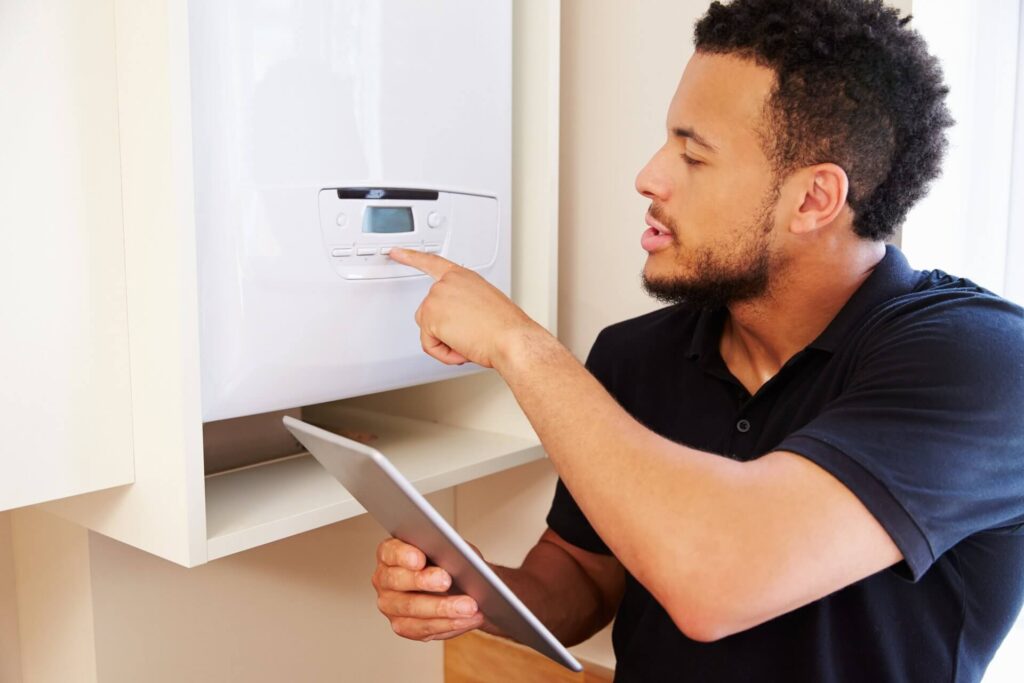
If your boiler is on but your radiators are not heating up, start with the simple stuff: the thermostat, the timer and the boiler pressure. Those three account for a surprising number of cold houses. If they’re all fine, the usual culprits are trapped air, sludge, a failing pump or a stuck diverter valve.
We’re Clever Energy Boilers, Gas Safe registered (no. 554138) and accredited Worcester Bosch installers based in Bingley. Over 15 years and more than 25,000 installations across Yorkshire, the North West and the Midlands, we’ve seen just about every reason a radiator refuses to warm up. Here’s how to work out which one you’re dealing with.
What should I check first?
Go through these before anything else. Each one takes a minute.
- Thermostat: is it set a few degrees above the current room temperature? Are the batteries flat?
- Timer or programmer: is the heating channel actually on right now?
- Boiler pressure: is the gauge above 1 bar?
- Boiler display: is there a fault code showing?
- Radiator valves: are the thermostatic valves turned up?
If you have a smart thermostat, check it’s still connected to Wi-Fi and the boiler. Our guide on smart thermostats covers how they talk to your boiler.
Why are my radiators not heating up?
Once the basics are ruled out, it’s usually one of these. The table gives you a quick way to narrow it down.
| What you notice | Likely cause | DIY or engineer? |
|---|---|---|
| Gauge below 1 bar | Low pressure | DIY top-up |
| Radiators cold at the top | Trapped air | DIY bleed |
| Radiators cold at the bottom | Sludge | Engineer, usually |
| Hot water works, heating doesn’t | Diverter or zone valve | Engineer |
| Boiler fires but pipes stay cold | Pump | Engineer |
| Furthest radiators cold, nearest hot | System needs balancing | DIY or engineer |
| Boiler stops in freezing weather | Frozen condensate pipe | DIY thaw |
Is the boiler pressure too low?
Below 1 bar, most boilers stop heating. Top it up using our guide on how to repressurise a boiler. If it keeps dropping, read why a boiler keeps losing pressure.
Is there air in the radiators?
Radiators that are cold at the top and warm at the bottom have trapped air. Bleeding them takes a few minutes with a radiator key. Our radiator bleeding guide shows you how. A bigger air pocket in the pipework is called an airlock and can stop several radiators working at once.
Is sludge blocking the radiators?
Cold bottoms and dark water when you bleed mean sludge. See our guide to a radiator that’s cold at the bottom.
Has the pump failed?
The pump pushes hot water round the system. If the boiler fires but the pipes stay cold, or you hear a hum with no flow, the pump may have seized. That’s a job for a Gas Safe engineer. Our post on a boiler pump that isn’t working explains the signs.
Is the diverter valve stuck?
On a combi, the diverter valve switches between heating and hot water. If it sticks in the hot water position, you’ll have hot taps but cold radiators. Our guide on a faulty diverter valve covers this, and so does our post on hot water but no heating.
Is a zone valve stuck on a system boiler?
System and regular boilers often use motorised zone valves to send hot water to the heating or the cylinder. A valve that sticks closed will leave the radiators cold. An engineer can test and replace it.
Does the system need balancing?
If radiators near the boiler get hot and those furthest away barely warm up, the system needs balancing. That means adjusting the lockshield valves so water is shared evenly. It takes patience but no special tools.
Has the condensate pipe frozen?
In a cold snap, the plastic pipe that drains water from your boiler can freeze and shut it down. Our guide on how to defrost your condensate pipe shows you how to thaw it safely.
Why are my radiators warm but not hot?
Lukewarm radiators usually come down to a low flow temperature setting on the boiler, a system that needs balancing, or light sludge. Turning the radiator temperature dial up a notch is a good first test. If that doesn’t help, the system may need cleaning.
When should I call a Gas Safe engineer?
Call one for anything involving the pump, diverter valve, zone valves or the inside of the boiler. Those parts sit near gas and electrical components, so they’re not DIY jobs.
Could an old boiler be the problem?
On a boiler over 8 years old, slow warm-ups, weak heat and repeated breakdowns are all signs it’s wearing out. Pumps, diverter valves and heat exchangers tend to fail in turn, and repair bills soon add up. Our post on when a boiler needs replacing goes through the warning signs.
We provide boiler replacement with fixed prices, and Clever Energy customers can choose long, market-leading warranty protection on their new boiler. If your radiators are tired too, our central heating team can upgrade them at the same time, and you can spread the cost with boiler finance.
Radiators not heating up FAQs
Why are my radiators cold but the hot water is hot?
On a combi, the diverter valve is the usual cause. On a system boiler, it’s often a stuck zone valve or a timer setting.
Why are only my upstairs radiators cold?
Air rises, so upstairs radiators are the first to get airlocked. Bleed them, then check the boiler pressure.
How long should radiators take to heat up?
Usually 10 to 20 minutes from cold. Much longer than that suggests sludge, low flow or a struggling boiler.
Why are my radiators cold when the boiler is on?
The boiler may be firing for hot water only, the pump may not be circulating, or a diverter or zone valve may be stuck. Check the thermostat and timer first, then the pressure.
Why is just one radiator not heating up?
That’s usually a valve problem on that radiator. Our guide to one radiator not working walks through the fixes.